Quick Answer
When discussing Mimosa Hostilis Root Bark compatibility skincare, the primary question is whether Mimosa tenuiflora can be incorporated into skincare and cosmetic formulations. The answer is yes. Mimosa tenuiflora-derived ingredients have a long history of use in cosmetic products, including creams, lotions, balms, serums, cleansers, and leave-on skincare formulations. Compatibility ultimately depends on formulation design, concentration, extraction methods, preservation systems, and individual skin sensitivity.
| Question | Quick Answer |
|---|---|
| Is Mimosa tenuiflora used in skincare? | Yes |
| Is it used in cosmetic products? | Yes |
| Can it appear in leave-on formulations? | Yes |
| Does compatibility depend on formulation? | Yes |
| Is patch testing recommended? | Yes |
What Does Mimosa Hostilis Root Bark Compatibility Skincare Mean?
The phrase Mimosa Hostilis Root Bark compatibility skincare refers to how Mimosa tenuiflora-derived ingredients interact within cosmetic and skincare formulations.
Compatibility may involve:
- Product type
- Ingredient combinations
- Extraction methods
- Product pH
- Stability systems
- Intended use
When formulators discuss compatibility, they are usually evaluating how a botanical ingredient performs within a finished cosmetic product rather than evaluating the raw botanical material by itself.
Why Is Mimosa Tenuiflora Used in Skincare?
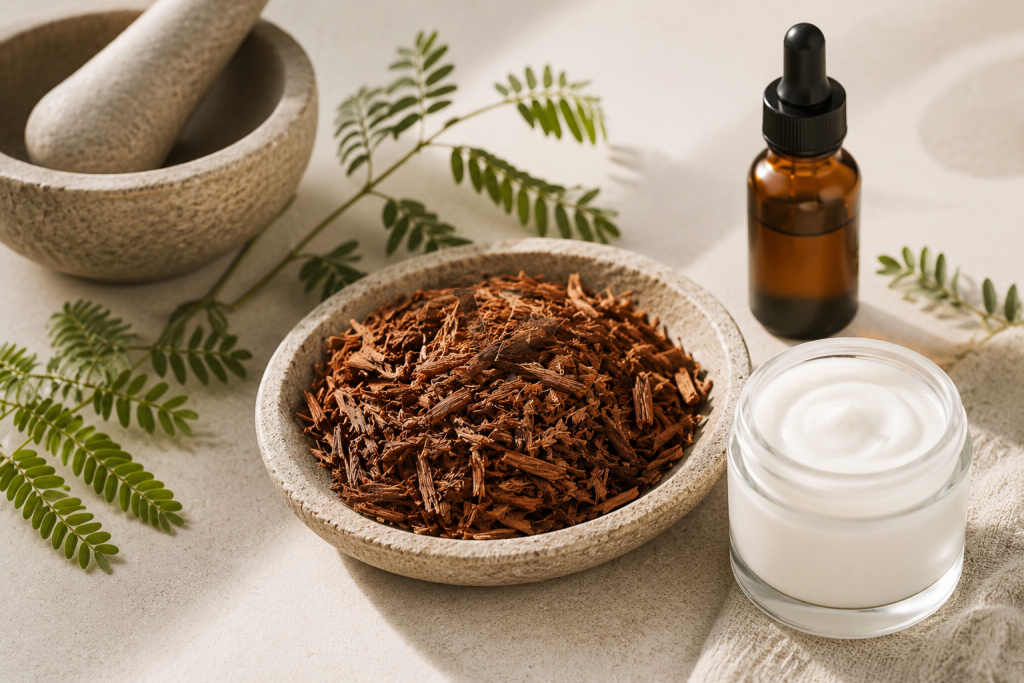
One reason discussions around Mimosa Hostilis Root Bark compatibility skincare continue to grow is the plant’s long history of cosmetic use.
Mimosa tenuiflora, commonly known in Mexico as tepezcohuite, has been incorporated into cosmetic products for many years. Cosmetic ingredient databases document its presence in facial products, moisturizers, body care products, serums, lotions, and topical skincare formulations.
The species has become particularly well known in botanical skincare due to its longstanding association with cosmetic applications.
Mimosa Hostilis Root Bark Compatibility Skincare and Leave-On Products
One of the most common questions formulators ask involves leave-on products.
Examples include:
- Creams
- Moisturizers
- Balms
- Serums
- Lotions
Mimosa tenuiflora-derived ingredients are found in a variety of leave-on cosmetic products currently available on the market. Cosmetic ingredient databases and product listings show the ingredient appearing in numerous skincare formulations.
However, compatibility always depends on the complete formulation rather than a single ingredient.
What Factors Influence Compatibility?
When evaluating Mimosa Hostilis Root Bark compatibility skincare, formulators typically consider several important variables.
Concentration
Higher ingredient concentrations may behave differently than lower concentrations within a formulation.
Extraction Method
Powders, extracts, and infused ingredients may perform differently depending on the intended product.
Product Type
Compatibility requirements differ between:
- Cleansers
- Creams
- Serums
- Balms
- Masks
Preservation Systems
Every cosmetic formulation requires appropriate preservation and stability considerations.
Individual Skin Sensitivity
Consumers may respond differently to botanical ingredients, which is why patch testing is commonly recommended when introducing a new product.
Common Skincare Products That May Contain Mimosa Tenuiflora
Many consumers are surprised to learn how frequently Mimosa tenuiflora appears in cosmetic products.
Examples include:
- Facial moisturizers
- Anti-aging products
- After-sun products
- Body creams
- Facial cleansers
- Serums
- Conditioning treatments
Ingredient databases list numerous commercial skincare products containing Mimosa tenuiflora-derived ingredients.
What Formulators Often Overlook
One of the most overlooked aspects of Mimosa Hostilis Root Bark compatibility skincare is that botanical compatibility involves the entire formulation.
Many new formulators focus exclusively on the botanical ingredient itself.
Experienced formulators often focus on:
- Overall formula design
- Ingredient interactions
- Stability
- Preservation
- Product testing
- User experience
The success of a skincare product rarely depends on a single ingredient.
Why Botanical Ingredients Require Special Consideration
Botanical ingredients differ from highly standardized synthetic ingredients because natural variation can occur.
Factors such as:
- Growing conditions
- Harvest timing
- Processing methods
- Storage conditions
may contribute to variation between botanical materials.
For more information on variation: https://tenuiflorashop.com/mimosa-tenuiflora-root-bark-vary-between-batches/
Related Skincare Resources
Learn more about Mimosa tenuiflora in skincare:
https://tenuiflorashop.com/how-does-high-quality-mimosa-tenuiflora-smell/
https://tenuiflorashop.com/does-mimosa-tenuiflora-root-bark-stay-fresh/
Key Takeaways
- Mimosa tenuiflora-derived ingredients are used in many cosmetic formulations.
- Mimosa Hostilis Root Bark compatibility skincare depends on complete formulation design.
- Leave-on skincare products commonly contain botanical ingredients derived from Mimosa tenuiflora.
- Compatibility involves concentration, extraction methods, preservation, and product type.
- Individual skin sensitivity can vary.
- Proper testing remains important when developing skincare products.
Frequently Asked Questions
Is Mimosa tenuiflora used in skincare products?
Yes. Mimosa tenuiflora-derived ingredients appear in a variety of cosmetic and skincare formulations.
What does Mimosa Hostilis Root Bark compatibility skincare mean?
It refers to how Mimosa tenuiflora-derived ingredients function within cosmetic formulations and skincare products.
Is Mimosa tenuiflora used in leave-on skincare?
Yes. Cosmetic databases list Mimosa tenuiflora-derived ingredients in numerous leave-on skincare products.
Does compatibility depend on concentration?
Yes. Concentration is one of several factors formulators consider during product development.
Is patch testing recommended?
As with many cosmetic ingredients, patch testing is commonly recommended when trying new skincare products.
Can botanical ingredients vary naturally?
Yes. Natural variation can occur due to environmental and processing factors.
Does Mimosa tenuiflora appear in commercial cosmetic products?
Yes. Numerous cosmetic products list Mimosa tenuiflora-derived ingredients.
What should formulators focus on?
Experienced formulators often prioritize stability, preservation, testing, and overall formulation performance.
External Resource
For additional information about cosmetic ingredients and products containing Mimosa tenuiflora-derived ingredients:
https://www.ewg.org/skindeep/browse/ingredients/703972-MIMOSA_TENUIFLORA_MIMOSA_BARK_EXTRACT
Final Thoughts
Understanding Mimosa Hostilis Root Bark compatibility skincare requires looking beyond a single ingredient. While Mimosa tenuiflora has a documented history of cosmetic use and appears in many skincare formulations, compatibility ultimately depends on the complete formulation, intended product type, ingredient interactions, and proper testing practices. For formulators and skincare enthusiasts alike, evaluating the entire formulation provides a more accurate picture than focusing on any one ingredient alone.