If you’ve shopped for Mimosa Hostilis Root Bark, you’ve probably noticed that the same botanical material is commonly sold in several forms: chunks, shredded bark, and finely milled powder.
At first glance, it can seem like these are different varieties or grades of Mimosa Hostilis. They aren’t.
Powder, shredded bark, and chunks are different physical forms of the same botanical material. The primary difference is how much the dried root bark has been mechanically reduced in size before it reaches the customer.
That processing changes practical characteristics such as texture, particle size, appearance, handling, and how much preparation may be required for a project. It does not turn the bark into a different botanical species or automatically make one form higher quality than another.
The accepted botanical name is Mimosa tenuiflora (Willd.) Poir., while Mimosa hostilis is recognized as a synonym. You can see the species record through the independent biodiversity database Global Biodiversity Information Facility (GBIF).
Understanding why these Mimosa Hostilis Root Bark forms exist makes it much easier to determine which physical format makes sense for your needs.
What Are the Different Forms of Mimosa Hostilis Root Bark?
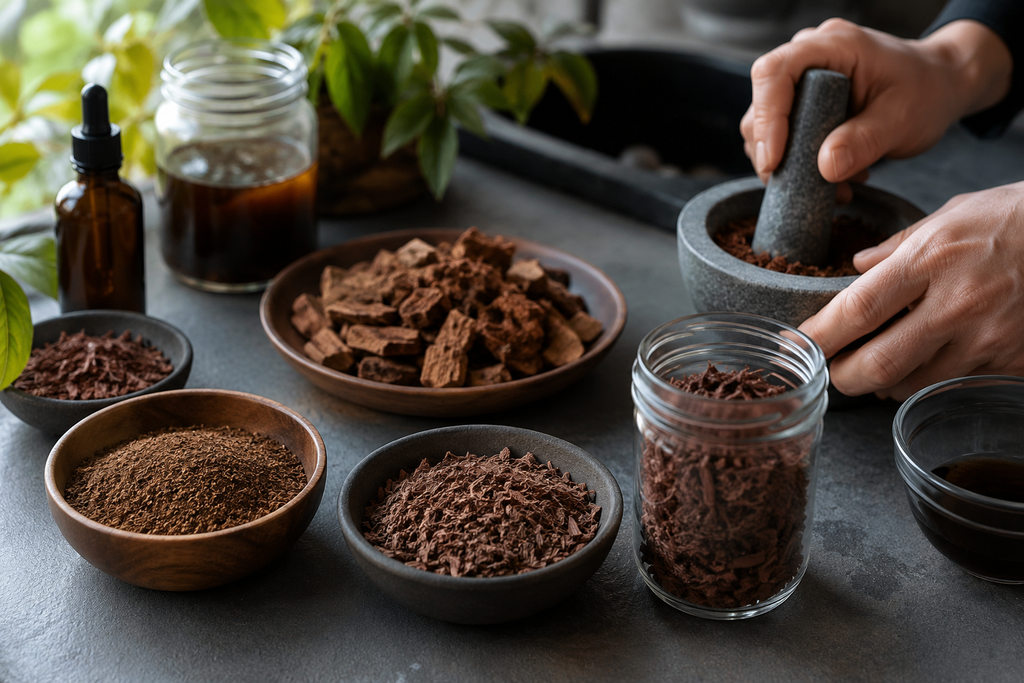
The three forms most commonly available are chunks, shredded root bark, and powder.
Think of them as different stages of physical size reduction:
Root bark → chunks → shredded bark → powder
Chunks remain in relatively large pieces. Shredded bark has been mechanically reduced into smaller, fibrous pieces. Powder has undergone additional milling to create a much finer and more uniform particle size.
The underlying botanical material remains Mimosa tenuiflora, commonly known as Mimosa Hostilis. What changes is primarily its physical form.
This distinction is important because terms such as “powder,” “shredded,” and “chunks” describe processing and particle size—not separate varieties of Mimosa Hostilis Root Bark.
Mimosa Hostilis Root Bark Chunks: The Least Size-Reduced Form
Mimosa Hostilis Root Bark chunks undergo the least size reduction of the three common forms.
Instead of being shredded or finely milled, the dried root bark remains in larger, irregular pieces. This makes much of the bark’s natural fibrous structure easy to see.
Because this form has undergone less mechanical processing, individual pieces can vary considerably in size, thickness, shape, texture, and coloration. That irregularity is normal for a natural botanical material.
Chunks may appeal to customers who want the bark in a form closer to its original physical structure or who prefer greater control over any additional size reduction.
The tradeoff is convenience. Larger pieces generally require more preparation if a project calls for smaller particles or finely milled botanical material.
You can explore the different sizes available in our Mimosa Hostilis Root Bark collection.
How Mimosa Hostilis Root Bark Becomes Shredded
Shredded root bark represents the middle ground between chunks and powder.
To produce shredded Mimosa Hostilis Root Bark, larger pieces of dried bark are mechanically reduced into smaller strands and fragments. The resulting material is easier to portion and handle while still retaining visible plant fibers and much of the bark’s natural texture.
This is why shredded MHRB looks distinctly different from powder. Rather than having a fine, relatively uniform consistency, shredded bark contains irregular fibers of different lengths, widths, and shapes.
For some customers, that intermediate level of processing is exactly the appeal.
The material has already undergone more size reduction than chunks, but it hasn’t been completely milled into powder. That provides flexibility for customers who prefer to keep the bark in a recognizable fibrous form or process smaller quantities further when needed.
Browse the available options in our Shredded Mimosa Hostilis Root Bark collection.
How Mimosa Hostilis Root Bark Becomes Powder
Mimosa Hostilis Root Bark Powder undergoes additional mechanical processing to reduce the dried bark to a much smaller particle size.
The result is a fine botanical powder with a more uniform texture than either shredded bark or chunks.
Because the milling has already been completed, powder offers convenience for applications that call for finely processed botanical material. There is no need for the customer to break down larger pieces before use.
That convenience is one reason MHRB powder is such a commonly available form.
However, the fact that powder has undergone more mechanical processing does not mean it is automatically a higher grade of root bark.
Likewise, chunks aren’t inherently superior simply because they’ve undergone less size reduction.
Assuming the source material and handling standards are comparable, the primary difference is how far the physical processing has been taken before packaging.
You can see the finished texture and available sizes in our Mimosa Hostilis Root Bark Powder collection.
What Actually Changes When Root Bark Is Processed?
Turning root bark into shreds or powder changes several physical characteristics of the material.
Particle Size
This is the most obvious difference.
Chunks contain relatively large pieces, shredded bark consists of smaller fibers and fragments, and powder consists of finely milled particles.
Texture
Processing changes how the material looks and feels when handled.
Chunks are coarse and irregular. Shredded MHRB remains visibly fibrous. Powder is fine and considerably more uniform.
Surface Area
Reducing a solid material into smaller particles increases the amount of surface area exposed relative to its volume.
This is a general principle of particle-size reduction and isn’t unique to Mimosa Hostilis. Research on powdered plant materials has demonstrated that reducing particle size through grinding can substantially increase surface area and change other physical properties of the resulting material. (ScienceDirect)
For readers interested in the science behind particle-size reduction, this peer-reviewed study published in Powder Technology examines the relationship between grinding, particle size and surface area in plant material: Effect of superfine pulverization on properties of Astragalus membranaceus powder.
Appearance
The same type of root bark can look surprisingly different after being shredded or powdered.
Large pieces display individual fibers, surfaces, edges, and natural color variations. Once those pieces are finely milled together, their visual characteristics become distributed across thousands of smaller particles.
As a result, powder may appear more visually uniform than chunks or shredded bark even when all three originated from comparable botanical material.
Handling and Preparation
The further the bark has already been mechanically reduced, the less size reduction a customer has to perform themselves.
This practical difference is one of the main reasons botanical suppliers offer multiple physical forms in the first place.
What Doesn’t Change Between the Forms?
This is where some confusion around MHRB forms comes from.
Grinding or shredding the root bark changes its physical structure, but it does not create a new botanical species.
Mimosa tenuiflora remains Mimosa tenuiflora whether the dried root bark is sitting in a large piece or has been mechanically milled into powder. GBIF’s botanical record also identifies Mimosa hostilis as a synonym associated with the accepted Mimosa tenuiflora name. (GBIF)
The form also doesn’t inherently tell you:
- Whether the bark is authentic
- How responsibly it was sourced
- How carefully it was dried
- How old it is
- How it was stored before reaching you
- Whether it was handled properly
- Its overall quality
Those characteristics depend on the source material and supply chain, not simply whether someone chose to shred or grind the bark.
This is why judging Mimosa Hostilis quality based solely on physical form can be misleading.
Why Do Suppliers Offer Powder, Shredded Bark, and Chunks?
Different customers want different levels of preparation.
Someone who wants a finely milled botanical material may have little reason to purchase chunks and process them at home. For that customer, powder eliminates an unnecessary step.
Another customer may prefer visibly fibrous botanical material but still want something easier to handle than large chunks. Shredded bark fills that middle position.
Others specifically prefer larger pieces because they want the material to undergo as little size reduction as possible before purchase or because they want control over further processing themselves.
Offering multiple forms allows customers to choose how much of that physical processing has already been completed.
It is less about offering three fundamentally different products and more about offering the same botanical material at different stages of physical preparation.
Does the Form Determine MHRB Quality?
No. Powder, shredded bark, and chunks should not be treated as quality grades.
A finely milled powder isn’t automatically better root bark because more processing went into it. Shredded bark isn’t inherently fresher because its fibers are still visible. And chunks aren’t necessarily higher quality simply because they’re closer to the bark’s original physical form.
Quality involves a much broader set of factors, including botanical identity, sourcing, processing conditions, storage, cleanliness, and handling.
The same principle applies to price.
Differences in pricing between forms can reflect additional processing, labor, equipment, packaging, and other supply-chain costs. A higher price for one form doesn’t necessarily mean the botanical material itself is of a higher grade.
When comparing MHRB, form and quality should be evaluated as separate characteristics.
Why Can Powder, Shredded Bark, and Chunks Look Different?
One of the more interesting consequences of processing is that the three forms don’t always look like identical versions of one another.
Imagine a piece of natural root bark containing darker fibers, lighter surfaces, reddish areas, and deeper burgundy tones.
As a chunk, those differences remain visually distinct.
Shredding mixes smaller pieces together while still leaving individual fibers visible.
Grinding the same type of material into powder blends those visual differences across a much smaller particle size. Lighting also interacts differently with a fine powder than it does with rough, irregular pieces of bark.
This means Mimosa Hostilis powder can appear different from shredded bark or chunks without that difference necessarily indicating a problem.
Natural variation between batches adds another layer. Root bark is a botanical material, so perfect visual uniformity should not be expected from one batch to the next.
For a deeper explanation of the factors behind those differences, read our guide, Why Does Mimosa Hostilis Root Bark Vary in Color?.
Can You Turn Chunks or Shredded MHRB Into Powder?
Yes. Larger physical forms can be mechanically reduced further.
In principle, the progression can move from:
Chunks → smaller pieces → shredded material → powder
This is one reason some customers intentionally purchase chunks or shredded MHRB. Instead of having the entire quantity arrive pre-milled, they can retain the coarser material and process smaller amounts further when their projects require it.
However, grinding tough, fibrous root bark can require suitable equipment. Household equipment isn’t necessarily designed to process dense botanical fibers, particularly when starting with larger chunks.
If you’re interested in understanding the different forms before deciding between them, our Mimosa Hostilis Powder vs. Shredded Root Bark guide provides a closer comparison.
Does the Form Affect Storage?
The basic storage principles for Mimosa Hostilis Root Bark are similar regardless of form: keep the material dry, properly sealed, and protected from excessive heat, moisture, and direct sunlight.
Particle size does, however, change the physical characteristics of the material. Finely milled powder has more exposed surface area than an equivalent mass kept in larger pieces. Research on plant powders has demonstrated the relationship between smaller particle size and increased surface area. (ScienceDirect)
That doesn’t mean powder is automatically “less fresh” than shredded bark or chunks.
For customers storing botanical material for an extended period, factors such as moisture exposure, packaging, storage conditions, and repeated opening of the container can all matter. We discuss those factors more thoroughly in Why Freshness Matters When Buying Mimosa Tenuiflora Root Bark. (Tenuiflora Shop)
Which Form of Mimosa Hostilis Root Bark Should You Choose?
There isn’t one universally “best” form of Mimosa Hostilis Root Bark.
The best choice depends primarily on how much physical processing you want completed before the material reaches you.
Choose powder when you want a fine, uniform botanical material without doing additional grinding yourself.
Choose shredded bark when you want a manageable, fibrous texture with the option to process it further.
Choose chunks when you prefer larger pieces and want the greatest control over subsequent size reduction.
If you’re mainly deciding between the two most commonly compared options, our Mimosa Hostilis Powder vs. Shredded Root Bark guide goes into greater detail.
Frequently Asked Questions About MHRB Forms
Are MHRB powder, shredded bark, and chunks the same thing?
They are different physical forms of the same type of botanical material. Powder has been finely milled, shredded bark has been reduced into smaller fibers and fragments, and chunks remain in larger pieces. The terms describe physical processing rather than different botanical species.
Is powdered MHRB more processed than shredded MHRB?
Yes, in terms of physical size reduction. Powder undergoes additional milling to create a much finer particle size. “More processed” in this context does not mean lower or higher quality; it simply describes the extent of mechanical processing.
Is shredded Mimosa Hostilis better than powder?
Neither form is inherently better. Shredded bark retains more visible fibrous structure, while powder provides a fine texture without additional grinding. The better choice depends on the intended application and preferred level of preparation.
Are MHRB chunks higher quality because they’re less processed?
Not necessarily. Larger pieces have undergone less size reduction, but that alone doesn’t establish quality. Sourcing, botanical identity, handling, drying, cleanliness, and storage are more meaningful considerations than particle size alone.
Can shredded Mimosa Hostilis be turned into powder?
Yes. Shredded root bark can be mechanically reduced to a finer particle size using appropriate equipment. Some customers choose shredded material because it gives them the option to process smaller quantities further as needed.
Why does MHRB powder look different from chunks?
Grinding changes particle size, texture, surface area, and the way light interacts with the material. Milling also distributes natural color variations across much smaller particles. As a result, powder can look different from chunks even when both originate from the same botanical species.
Does Mimosa Hostilis Root Bark form affect authenticity?
No. Physical form alone cannot establish authenticity. Genuine Mimosa tenuiflora can be sold as chunks, shredded bark, or powder. Authenticity should be evaluated using broader information about botanical identity, sourcing, supplier transparency, and the material itself.
Understanding the Form You’re Buying
The different forms of Mimosa Hostilis Root Bark ultimately give customers control over one simple variable: how much physical processing has already taken place.
Chunks retain more of the bark’s original structure. Shredded bark provides an intermediate texture. Powder arrives finely milled and requires the least additional size reduction.
None of those forms is automatically more authentic, more natural, or higher quality simply because of its particle size.
Once you understand that distinction, choosing between MHRB powder, shredded bark, and chunks becomes much simpler: choose the form that provides the level of preparation and physical texture that makes sense for your project.