If you’ve ever opened a new package of Mimosa Hostilis Root Bark and noticed that it looks slightly different from a previous order, that difference isn’t automatically a reason for concern. Natural botanical materials do not have the perfectly standardized appearance of manufactured ingredients, and variation in Mimosa Hostilis Root Bark color is normal.
Depending on the material, processing, particle size, storage, and even the lighting in which you view it, root bark may appear reddish-brown, burgundy, deep brown, muted purple, or somewhere between those shades.
The important point is that there is no single “correct” color that proves Mimosa Hostilis is fresh, authentic, or high quality.
Color can be one useful observation, but it needs context. Understanding why it varies is much more useful than trying to match your bark to one exact shade seen in a photograph online.
What Color Should Mimosa Hostilis Root Bark Be?
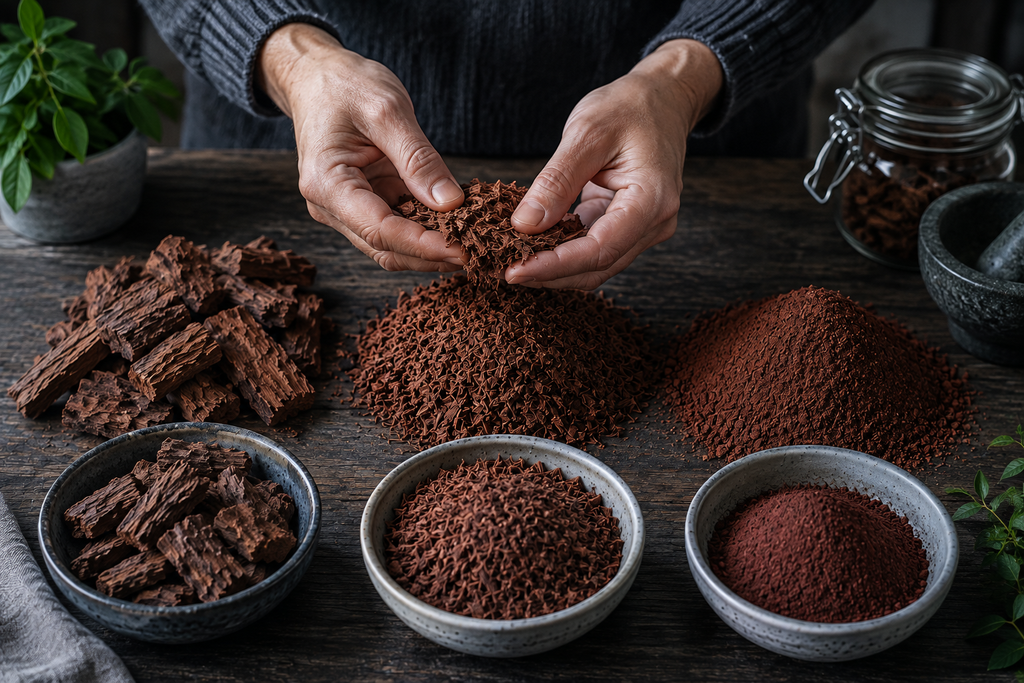
Mimosa Hostilis Root Bark can naturally display a range of reddish, brown, burgundy, and purple-toned colors. Its exact appearance may vary between batches and between powder, shredded bark, and chunks. No single shade should be treated as the universal standard for authentic or high-quality bark.
This is particularly important for customers purchasing MHRB for the first time.
Online photographs can create the impression that the material should always be a vivid purple or a particular shade of red. Real botanical material is considerably more variable.
You may encounter bark that appears:
- Deep reddish-brown
- Rust or brick-toned
- Burgundy
- Brown with reddish undertones
- Muted reddish-purple
- Dark brown or purple-brown
Different tones may also appear within the same package, particularly with larger pieces of bark.
Rather than asking whether the color matches one precise shade, it is more useful to understand what can cause those differences.
Why Does Mimosa Hostilis Root Bark Vary in Color?
Mimosa Hostilis Root Bark color can vary because plants are biologically variable materials. Growing conditions, individual plants, the portion of bark present, drying, cleaning, processing, particle size, exposure to the environment, and storage can all affect how the finished botanical material appears.
Unlike a manufactured pigment, natural bark is not produced according to a color formula.
Even material belonging to the same botanical species can show differences from one harvest or batch to another.
The plant commonly called Mimosa Hostilis is botanically recognized as Mimosa tenuiflora. Both GBIF and World Flora Online recognize Mimosa tenuiflora (Willd.) Poir. as an accepted species name, with Mimosa hostilis included among its synonyms.
That botanical identity does not mean every piece of harvested material will look identical. World Flora Online’s botanical descriptions themselves note color variation in dried plant structures, illustrating a broader point that plant appearance can change naturally and after drying.
Why Can Two Batches of MHRB Look Different?
Two batches of MHRB can look different without one necessarily being better than the other. Botanical materials vary naturally, and separate batches may differ in source material, harvest conditions, drying, processing, particle size, or storage history.
Think about other minimally processed plant materials: tea leaves, spices, dried herbs, coffee beans, and natural woods rarely look perfectly identical from batch to batch.
Root bark is no different.
A previous order might have appeared more burgundy, while a newer batch looks reddish-brown. One powdered batch might appear especially dark, while another looks slightly lighter under the same room lighting.
The existence of a visible difference does not, by itself, tell you why the difference occurred.
This is why comparing a new batch exclusively against your memory of an older one can be misleading.
Does Growing Region Affect Mimosa Hostilis Color?
Growing environment can contribute to natural botanical variation, but geographic origin should not be used as a simple color-based quality test. Environmental conditions differ across growing regions, yet color alone cannot reliably establish where a particular batch originated or whether one origin is superior.
Mimosa tenuiflora occurs across multiple parts of the Americas rather than in one narrowly defined habitat. World Flora Online records the species across regions including Mexico, Brazil, and portions of Central and South America.
Plants growing under different environmental conditions are not expected to be visually identical.
However, it would be an oversimplification to say something like “Mexican bark is always this color” or “darker bark must come from this region.”
Those kinds of visual rules ignore the many other variables involved between a living tree and the finished botanical material in a customer’s package.
Origin is useful information. It just shouldn’t be inferred from color alone.
How Can Processing Change the Appearance of Root Bark?
Processing can noticeably affect the perceived color of root bark. Cleaning changes which surfaces and plant material remain visible, drying alters the appearance of fresh plant tissue, and grinding changes how much surface area is exposed to light.
This becomes particularly noticeable when comparing chunks with finely processed powder.
A large piece of bark has ridges, fibers, exposed edges, interior surfaces, and shadows. Those features create visible contrast.
Once the same type of botanical material is reduced to much smaller particles, light interacts with it differently. Thousands of small particles collectively create a much more uniform visual field.
Particle size matters too.
A very fine powder can appear different from a coarser powder even when both originate from similar source material. The smaller particles scatter and absorb light differently, while larger fibers create additional shadows and highlights.
That means Mimosa Hostilis Root Bark powder color should not necessarily be expected to perfectly match the appearance of unprocessed pieces.
Why Do Powder, Shredded Bark, and Chunks Look Different?
Powder, shredded bark, and chunks can appear different because each form exposes the bark differently to light. Powder creates a relatively uniform surface, shredded material contains numerous fibers and shadows, and chunks expose larger exterior and interior surfaces.
This can make three forms of the same botanical material look surprisingly different when placed side by side.
Powder
Finely milled material tends to have the most visually uniform appearance.
Because so many small particles are visible together, subtle reddish or purple undertones can become more apparent. Lighting also has a large effect on how a mound of powder photographs.
Customers comparing finely processed material can view our Mimosa Hostilis Root Bark powder collection.
Shredded Bark
Shredded material has significantly more visible texture.
Individual fibers face different directions, creating highlights and shadows throughout the material. Some pieces may therefore look darker or lighter even when they came from the same batch.
Our shredded Mimosa Hostilis Root Bark collection shows the characteristic fibrous appearance of this form.
Chunks
Chunks preserve the greatest amount of visible natural structure.
One surface may look dark brown while a broken or exposed interior surface appears more reddish. Deep crevices can look nearly black in photographs simply because they receive less light.
You can compare that appearance with our Mimosa Hostilis Root Bark chunks.
The takeaway is simple: comparing the color of a chunk directly against a photograph of finely milled powder isn’t particularly useful. Texture changes how we perceive color.
Does Darker Mimosa Hostilis Root Bark Mean Better Quality?
Not necessarily. Darker MHRB should not automatically be considered higher quality, and lighter material should not automatically be considered inferior. Color is influenced by too many natural and processing variables to function as a reliable standalone quality grade.
This is one of the easiest assumptions to make when shopping online.
If two products are photographed next to each other and one has a richer, darker appearance, it’s tempting to assume that the darker product must be more desirable.
But photographs don’t reveal enough information to support that conclusion.
A difference in darkness could reflect particle size, lighting, processing, moisture, source material, camera exposure, or natural variation.
Mimosa Hostilis quality should therefore be evaluated using more context than a simple dark-versus-light comparison.
Does Purple Mimosa Hostilis Root Bark Mean It’s Authentic?
Purple or burgundy undertones can occur in Mimosa Hostilis Root Bark, but purple color alone does not prove authenticity. Likewise, bark does not need to match one vivid purple shade to be legitimate. Botanical identity should never be established from color alone.
This distinction matters because “purple Mimosa Hostilis Root Bark” has become a common visual expectation online.
A customer may receive reddish-brown material and wonder why it doesn’t look as purple as a product photograph they previously saw. Another batch may appear much more purple under daylight than under warm indoor lighting.
Neither observation is enough to verify botanical identity.
Color can be part of the overall visual assessment, but it should remain exactly that: one characteristic among several.
For a broader discussion of identification considerations, see our 5 Signs You’re Buying Authentic Mimosa Hostilis Root Bark article.
[INTERNAL LINK: Insert the existing authenticity article URL here.]
Does Color Indicate Freshness?
Color alone is not a reliable test of freshness. A darker or brighter appearance does not automatically mean a batch is newer, and a slightly different shade does not automatically mean botanical material is old.
Freshness involves the condition of the material and how it has been handled throughout harvesting, drying, packaging, shipping, and storage.
Those factors cannot be reduced to a color chart.
If you’re evaluating freshness specifically rather than appearance, our dedicated freshness guide explains the subject in much greater detail.
[INTERNAL LINK: Insert the existing freshness article URL here.]
Can Storage Change Mimosa Hostilis Root Bark Color?
Storage conditions can influence the appearance of dried botanical materials over time. Light, air, humidity, heat, and moisture exposure can all contribute to changes in plant material, which is why stable storage conditions are preferable.
That doesn’t mean every subtle color change indicates a storage problem.
Natural materials continue to interact with their environment, and visual appearance may shift gradually. What matters more is whether the product has been stored appropriately and remains in good physical condition.
For detailed storage recommendations, see our dedicated guide to storing Mimosa Hostilis Root Bark.
[INTERNAL LINK: Insert the existing storage article URL here.]
Can You Judge Mimosa Hostilis Quality by Color Alone?
No. Mimosa Hostilis Root Bark color should not be used by itself to determine quality, authenticity, freshness, or botanical identity. Color is too easily influenced by natural variation, processing, particle size, storage, lighting, and photography.
A more useful evaluation considers the entire product and supplier context.
That may include:
- Clearly identified botanical material
- Transparent sourcing information
- Appropriate processing
- Overall physical condition
- Consistency within the form being purchased
- Appropriate packaging
- Reliable supplier information
Color can certainly be observed. It simply shouldn’t be asked to prove something it cannot prove.
This is probably the single most important point to remember from this guide.
Why Don’t Product Photos Always Match the Bark Exactly?
Product photography can make the same bark appear noticeably different. Lighting temperature, exposure, white balance, shadows, camera processing, screen settings, and particle orientation can all influence perceived color.
This is especially relevant when buying botanical materials online.
A photograph taken beside a window under cool daylight may make reddish-purple undertones more visible. The same material photographed under warm indoor lighting may appear considerably browner.
Screens introduce another variable.
Phone displays, computer monitors, brightness settings, color profiles, and features such as Night Shift can all alter the image you’re seeing.
Texture creates additional differences. A pile of powder photographed from above reflects light differently from loose shredded fibers, while chunks create deep shadows around their irregular surfaces.
For that reason, ecommerce photography should be treated as a useful representation of a natural product—not a digital color swatch your order must match exactly.
What Should You Look for Instead of One “Perfect” Color?
Instead of searching for one supposedly perfect MHRB color, look for context. Botanical identity, supplier transparency, appropriate processing, product condition, and realistic information about natural variation tell you more than whether a batch matches a particular shade online.
A reasonable visual assessment can still be useful.
If something appears dramatically different from what you ordered, contacting the supplier and asking questions makes sense. What buyers should avoid is treating minor shade differences as automatic proof of either exceptional quality or a problem.
Natural botanical materials are supposed to have some variation.
A credible supplier should acknowledge that rather than promising every harvest will look identical.
For customers comparing forms, The Tenuiflora Shop provides carefully sourced Mexican Mimosa tenuiflora Root Bark in powder, shredded, and chunk formats for legal botanical and creative applications. The goal is consistency and careful handling while recognizing that natural plant materials will never have the absolute visual uniformity of a manufactured ingredient.
Frequently Asked Questions
What color is Mimosa Hostilis Root Bark?
Mimosa Hostilis Root Bark may display reddish-brown, burgundy, brown, purple-brown, and related natural tones. Exact appearance varies with the botanical material, processing, particle size, lighting, and other factors. There is no single shade that every authentic batch must match.
Why is my MHRB powder purple?
Purple or burgundy undertones can naturally be visible in powdered root bark. Fine grinding changes how the material interacts with light and can make certain undertones more noticeable. Purple color by itself, however, should not be considered proof of quality or authenticity.
Is brown Mimosa Hostilis Root Bark normal?
Yes. Brown and reddish-brown tones can occur naturally in Mimosa Hostilis Root Bark. A batch does not need to appear vividly purple to be considered normal botanical material.
Does darker MHRB mean higher quality?
No. Darkness alone is not a reliable quality indicator. Growing conditions, processing, particle size, moisture, storage, lighting, and photography can all influence how dark a batch appears.
Does Mimosa Hostilis Root Bark change color over time?
The appearance of dried botanical materials can gradually change depending on environmental exposure and storage conditions. Light, air, moisture, humidity, and heat may influence appearance over time, which is one reason appropriate storage is important.
Can powder and shredded Mimosa Hostilis be different colors?
Yes. Powder and shredded bark can appear different even when derived from similar material. Powder creates a uniform field of tiny particles, while shredded bark contains fibers positioned at different angles that create highlights and shadows.
Is Mimosa Hostilis the same as Mimosa Tenuiflora?
The name Mimosa Hostilis remains widely used commercially, while Mimosa tenuiflora (Willd.) Poir. is recognized as an accepted species name by major botanical databases; Mimosa hostilis appears among its synonyms.
Can color prove that MHRB is authentic?
No. Color alone cannot prove botanical identity. It can be one observable characteristic, but authenticity should be evaluated using broader information about identification, sourcing, processing, condition, and supplier transparency.
Final Thoughts
If your Mimosa Hostilis Root Bark looks slightly different from a previous batch or from a photograph online, the difference does not automatically indicate a problem.
Mimosa Hostilis Root Bark color exists on a natural spectrum rather than as one standardized shade. Plant variation, growing conditions, source material, drying, processing, particle size, environmental exposure, storage, and even the light in your room can influence what you see.
Powder may appear different from shredded bark. Shredded bark may appear different from chunks. One harvest may not perfectly match another.
What matters is resisting the temptation to turn color into a quality test it was never capable of being.
Dark doesn’t automatically mean better. Purple doesn’t automatically mean authentic. Brown doesn’t automatically mean poor quality. And a photograph on a website should never be treated as an exact color standard for a natural botanical material.
Color is useful information when viewed in context.
It just isn’t the whole story.