Yes. Mimosa Hostilis Root Bark texture can affect how the material is handled, measured, stored, and physically prepared because powder, shredded bark, and chunks have different particle sizes and structures. Powder has undergone the greatest particle-size reduction, shredded bark retains visible fibers and larger particles, and chunks preserve larger pieces of the bark’s original structure.
Those differences are physical. Texture does not create a different botanical species, nor does a finer or coarser texture automatically indicate higher quality.
For buyers, the practical question is therefore less about which texture is “best” and more about how much physical preparation they want completed before the material reaches them.
What Does “Texture” Mean With Mimosa Hostilis Root Bark?
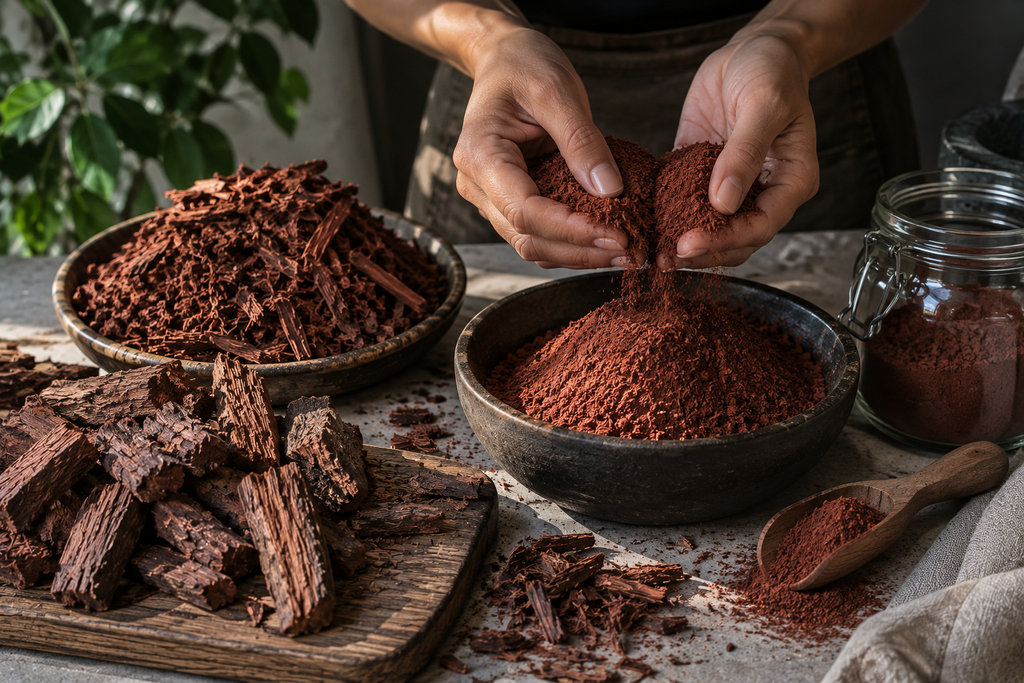
MHRB texture refers primarily to the material’s physical form: particle size, fiber length, surface structure, uniformity, and the amount of size reduction it has undergone. Texture exists on a spectrum rather than within three perfectly standardized categories.
Commercial products are commonly described as powder, shredded bark, or chunks, but those labels do not necessarily represent universal particle-size specifications.
One supplier’s shredded material may contain longer or coarser fibers than another’s. Powders can also vary in fineness, while chunks naturally differ in size and shape.
A useful way to visualize the spectrum is:
Fine powder → coarse powder → fine shreds → larger fibers → small chunks → larger chunks
The boundaries between those descriptions are not necessarily identical from one processor to another.
Our guide to how Mimosa Hostilis Root Bark is processed after harvest explains how physical size reduction creates these different forms without assuming every producer follows the same processing method.
Does MHRB Texture Change the Botanical Material?
No. Cutting, shredding, or milling changes the physical dimensions of root bark, but it does not turn the underlying plant material into a different botanical species.
The plant widely called Mimosa Hostilis in commerce is botanically recognized as Mimosa tenuiflora (Willd.) Poir. World Flora Online lists Mimosa tenuiflora as an accepted species in the Fabaceae family and includes Mimosa hostilis among its synonyms. (World Flora Online)
World Flora Online — Mimosa tenuiflora botanical record
If that botanical material is cut into chunks, reduced to fibers, or finely milled, its physical form changes. Its botanical identity does not.
That distinction matters because “powder,” “shredded,” and “chunks” describe how the material has been physically prepared, not separate botanical varieties.
How Does Powdered MHRB Feel and Handle?
Mimosa Hostilis Root Bark powder consists of finely reduced particles that create a comparatively uniform texture. Because the material has already been milled, no additional grinding is necessary for someone specifically seeking a fine physical form.
Compared with shredded bark and chunks, powder generally:
- Has much smaller particles
- Feels more uniform
- Is straightforward to weigh and portion
- Can settle or compact inside its package
- Can disperse more easily during handling
- Requires no further size reduction to achieve a powdered texture
The fineness that makes powder uniform also means loose particles can create dust more readily than larger forms. Keeping containers or packaging securely closed helps contain the material during storage.
Buyers who specifically prefer a finely milled texture can view the Mimosa Hostilis Root Bark powder collection.
How Does Shredded MHRB Feel and Handle?
Shredded Mimosa Hostilis Root Bark retains visible fibers and has less uniform particle dimensions than powder. It represents an intermediate level of physical size reduction: considerably smaller than chunks while preserving much more recognizable plant structure than finely milled material.
Individual fibers may vary in length, thickness, and orientation.
That gives shredded bark a visibly different physical character from powder. It tends to appear looser and more irregular, and the fibrous structure remains easy to see.
Shredded material also gives buyers some flexibility. It has already undergone substantial physical preparation but can be reduced further if a finer texture is preferred later.
The shredded Mimosa Hostilis Root Bark collection shows what this intermediate texture looks like in practice.
How Do MHRB Chunks Feel and Handle?
MHRB chunks consist of larger, irregular pieces that preserve more of the root bark’s visible physical structure. Of the three common commercial forms, chunks have undergone the least particle-size reduction.
Fibers, broken surfaces, edges, thickness differences, and other natural structural features are consequently much easier to see.
Chunks are also inherently less uniform than finely processed material. Two pieces from the same batch do not need to have identical dimensions.
For someone who eventually wants a smaller particle size, chunks require more physical preparation than shredded bark or powder. For someone who specifically prefers larger pieces, that limited processing is the point.
You can compare the physical structure through The Tenuiflora Shop’s Mimosa Hostilis Root Bark chunks.
Why Does MHRB Particle Size Matter?
Particle size matters because reducing a solid material into smaller pieces increases its exposed surface area and changes practical characteristics such as handling, dispersion, physical uniformity, packing behavior, and how easily the material can undergo further size reduction.
This isn’t unique to Mimosa Hostilis.
The University of Wisconsin–Madison’s Wisconsin Energy Institute describes size reduction of plant biomass as mechanical processes such as cutting, chopping, and grinding, and notes that reducing particle size increases specific surface area. (Wisconsin Energy Institute)
University of Wisconsin–Madison: Size Reduction
For MHRB, that basic physical principle helps explain why a bag of powder behaves differently from a bag containing the same weight of large pieces.
Smaller particles can:
- Disperse more readily
- Pack together differently
- Produce a more visually uniform material
- Generate more fine dust during handling
- Require less additional physical processing
Larger pieces behave differently because more of the material remains contained within continuous pieces rather than distributed among many small particles.
None of this implies that one form contains “better” botanical material. It simply explains why particle size has practical consequences.
Does Texture Affect How MHRB Looks?
Yes. Powder, shredded bark, and chunks can look noticeably different even when they originate from similar botanical material. Particle size changes how fibers, surfaces, shadows, and natural color variation are visually presented.
Powder blends many small particles together, often creating a more uniform overall appearance.
Shredded bark exposes individual fibers facing different directions, producing more highlights and shadows.
Chunks show larger sections of the bark individually, making differences between surfaces and pieces easier to see.
Lighting and photography can exaggerate those differences further.
Most importantly, color alone cannot establish the authenticity, freshness, or overall quality of Mimosa Hostilis Root Bark.
We cover that issue separately in Why Does Mimosa Hostilis Root Bark Vary in Color?, rather than turning texture into an unreliable color-based quality test.
Does MHRB Texture Affect Measuring and Portioning?
Yes. Different MHRB textures occupy space differently, so equal-looking volumes of powder, shredded bark, and chunks should not be assumed to represent equal quantities of material. Weight provides a more consistent basis for comparing quantities across different physical forms.
This becomes easy to understand when you look at the structure.
Powder can settle and compact, allowing small particles to occupy spaces between one another.
Shredded bark contains irregular fibers with considerable air space between them.
Chunks are larger and pack together differently again.
A container filled to the same visible level with each form could therefore contain different amounts by weight.
For product comparison and inventory purposes, weight is much more useful than trying to judge quantity by how full a package appears.
Does Texture Affect Storage?
Texture can affect the practical way MHRB is stored, but all forms should be protected from unnecessary moisture, excessive heat, and prolonged direct sunlight. There isn’t enough basis to claim that one texture universally remains fresh longer simply because of its particle size.
The practical storage differences are more straightforward.
Powder consists of fine particles that can disperse easily, making securely closed packaging particularly useful.
Shredded bark contains irregular fibers and may occupy more physical volume for a given weight because the fibers do not pack as densely.
Chunks consist of larger individual pieces that are easy to physically handle, although their irregular shapes can also affect how efficiently they occupy storage space.
Those are packaging and handling differences rather than evidence that one texture is inherently more stable.
For longer-term storage considerations, use our dedicated Mimosa Hostilis Root Bark storage guide rather than relying on texture alone.
Does Finer MHRB Mean Higher Quality?
No. Finer MHRB does not automatically mean higher-quality MHRB. Particle size describes physical processing, not botanical quality.
A finely milled powder may be exactly what one customer wants, while another may intentionally prefer visible shredded fibers or larger chunks.
Likewise, chunks aren’t automatically more authentic or “natural” simply because they have undergone less size reduction.
A more meaningful assessment considers factors such as:
- Botanical identification
- Source material
- Cleanliness
- Processing and handling
- Condition
- Appropriate storage
- Packaging
- Supplier transparency
Texture tells you something useful about how the material has been physically prepared.
It cannot tell you everything about the material itself.
Why Can Two Suppliers Have Different MHRB Textures?
Two suppliers can sell products under the same general texture description while providing material that looks somewhat different. There does not appear to be a universal commercial particle-size specification requiring every MHRB powder, shred, or chunk product to have identical dimensions.
Differences may result from:
- Grinding or milling equipment
- Screens used during processing
- Shredding equipment
- Desired particle-size range
- Natural fiber structure
- Source material
- Sorting
- Individual processor preferences
For example, one product labeled “powder” may be noticeably finer than another. One supplier’s shredded material may contain longer fibers than another’s.
Those differences are worth noticing, but they should not automatically be interpreted as quality differences.
You can compare our available Mimosa Hostilis Root Bark powder, shredded bark, and chunks to choose the physical form that best fits your needs.
Which MHRB Texture Should You Choose?
There is no universally best MHRB texture. The most practical choice depends largely on how much physical processing you want completed before the material reaches you.
Choose powder if: you want a fine, relatively uniform physical texture and don’t want to reduce the particle size yourself.
Choose shredded bark if: you prefer visible fibers and an intermediate level of physical processing.
Choose chunks if: you prefer larger pieces that retain more of the root bark’s original physical structure and don’t mind additional preparation if you eventually want a finer texture.
That’s really the decision.
Texture should serve your practical preferences rather than being treated as a ranking system from “worst” to “best.”
For a broader explanation of why these options exist in the first place, see Why Is Mimosa Hostilis Root Bark Sold in Different Forms?
What We’ve Observed From Working With Different MHRB Textures
The Tenuiflora Shop regularly handles Mexican-sourced MHRB in powder, shredded, and chunk forms, and the physical differences become very obvious when the three are handled side by side.
Powder appears substantially more uniform because individual fibers have been reduced into fine particles. It also settles differently in packaging and requires more care during handling because small particles disperse easily.
Shredded bark still looks unmistakably fibrous. Individual pieces vary in length and orientation, giving it a much looser appearance than powder.
Chunks display the most obvious original physical structure. Differences between individual pieces, exposed fibers, broken surfaces, and natural color variation are easier to see because they haven’t been visually blended together through fine milling.
We’ve also seen firsthand why photographs can make the textures appear more different in color than expected. A mound of fine powder interacts with light very differently from irregular shredded fibers or large pieces with deep shadows.
In practical terms, customers tend to be choosing between convenience and control over physical preparation. Powder arrives with the size reduction already completed. Shredded bark sits in the middle. Chunks leave the most physical preparation to the customer if a smaller texture is eventually desired.
Those are meaningful differences. They just aren’t quality grades.
Frequently Asked Questions About MHRB Texture
Does Mimosa Hostilis Root Bark texture matter?
Yes. MHRB texture affects practical characteristics including handling, particle size, physical uniformity, storage behavior, and the amount of additional preparation required. Powder, shredded bark, and chunks behave differently physically, although those differences do not automatically indicate different botanical quality.
Is powdered MHRB better than shredded MHRB?
No. Powdered MHRB isn’t inherently better than shredded bark. Powder offers a fine, uniform texture with no additional grinding required, while shredded bark preserves visible fibers and provides an intermediate level of size reduction. The better option depends on the physical form a buyer prefers.
Are MHRB chunks higher quality than powder?
Not inherently. Chunks have undergone less particle-size reduction, but that does not automatically make them higher quality or more authentic. Botanical identity, source material, cleanliness, processing, handling, storage, packaging, and supplier transparency provide more useful quality information than particle size alone.
Does grinding MHRB change its quality?
Grinding changes physical properties such as particle size, surface area, texture, and appearance. Grinding by itself does not establish whether the underlying botanical material is higher or lower quality. Quality should be evaluated using broader information about the material and how it was sourced, handled, processed, and stored.
Why does powdered MHRB look different from shredded bark?
Powder contains many small particles that visually blend together, producing a relatively uniform surface. Shredded bark retains individual fibers positioned at different angles, creating highlights, shadows, and visible variation. As a result, similar botanical material can look noticeably different after physical size reduction.
Does MHRB particle size affect surface area?
Yes. As a solid material is divided into smaller particles, its specific exposed surface area increases. This is a general physical principle of size reduction and helps explain why powder handles and disperses differently from larger fibers or chunks. It does not, by itself, establish product quality. (Wisconsin Energy Institute)
Is shredded MHRB the same botanical material as powder?
It can be. Shredded bark and powder describe physical forms rather than different species. Mimosa tenuiflora remains the underlying botanical identity whether its root bark is left in larger pieces, shredded into fibers, or finely milled. (World Flora Online)
Why is some MHRB powder finer than others?
Commercial powders can vary because producers may use different milling equipment, processing targets, screens, source material, and particle-size preferences. “Powder” does not necessarily indicate one universal particle-size specification, so a somewhat coarser or finer powder isn’t automatically evidence of superior or inferior quality.
Which MHRB texture is easiest to handle?
That depends on what “easy” means for the buyer. Powder requires no additional size reduction but contains fine particles that can disperse during handling. Shredded bark has larger visible fibers, while chunks are easy to handle individually but require more preparation if a finer texture is eventually wanted.
Does MHRB texture affect storage?
Texture affects practical storage characteristics such as packing density, physical volume, and how easily loose particles disperse. However, powder, shredded bark, and chunks should all be kept appropriately dry and protected from unnecessary moisture, excessive heat, and prolonged direct sunlight.
The Practical Difference Comes Down to Physical Form
Mimosa Hostilis Root Bark texture matters primarily because it changes the physical characteristics of the material.
Powder, shredded bark, and chunks differ in particle size, uniformity, handling, packing behavior, appearance, and how much additional physical preparation they require. Those differences can be significant when you’re actually working with the material.
What they don’t automatically represent are different levels of botanical quality.
Powder isn’t inherently superior because it’s finer. Chunks aren’t inherently superior because they’re less processed. Shredded bark isn’t inherently a better compromise for every buyer.
The best choice is the form that matches how you prefer to handle botanical material and how much physical preparation you want completed beforehand.
The Tenuiflora Shop offers Mexican-sourced Mimosa Hostilis Root Bark in powder, shredded, and chunk forms so customers can compare the available textures and choose the physical form that makes the most sense for their legal botanical and creative applications.