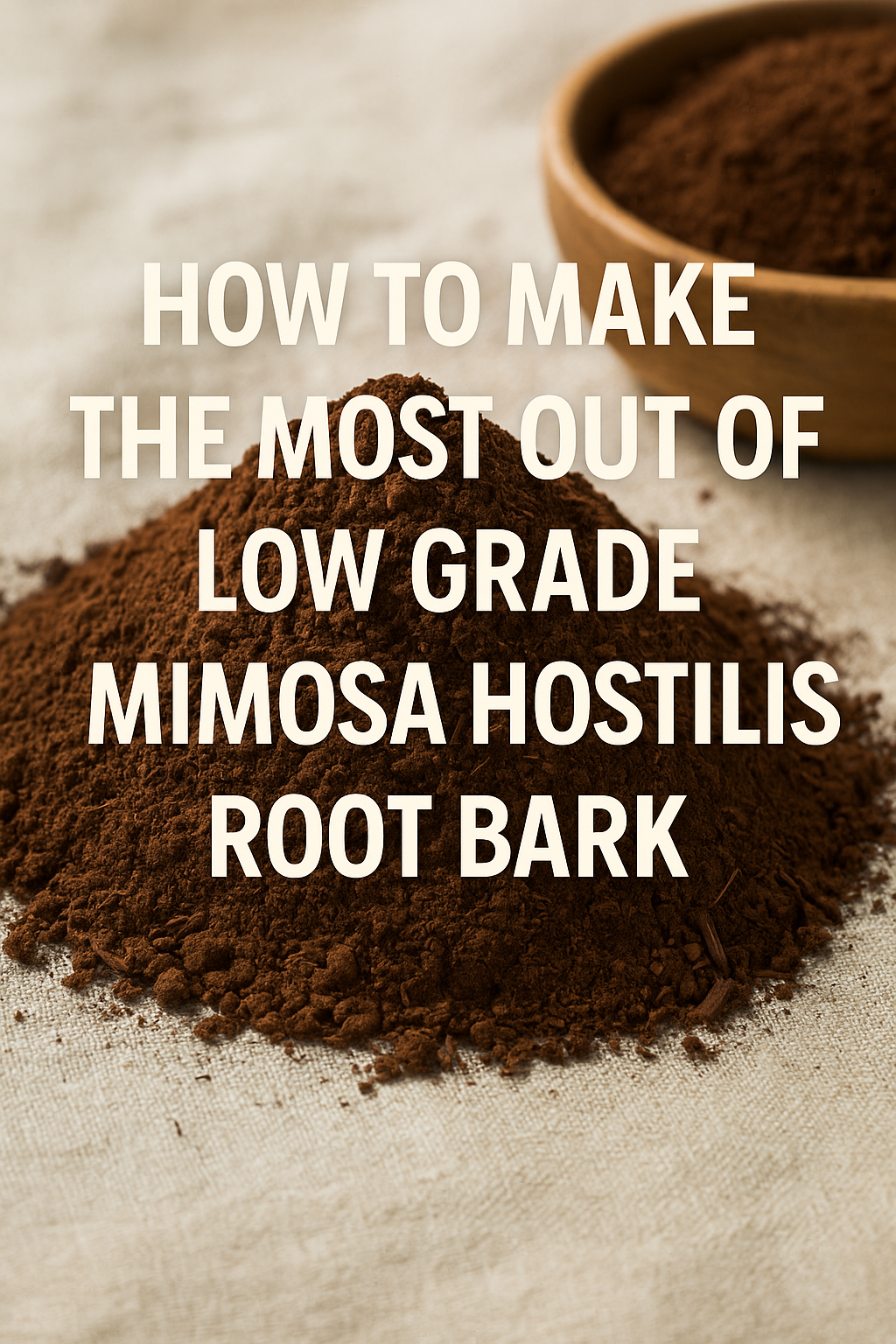
Not all Mimosa Hostilis Root Bark (MHRB) is created equal. Some batches arrive vibrant, aromatic, and richly colored — while others feel dull, dusty, or weaker than expected. If you’ve ever opened a bag and worried that your dye bath or soap project is doomed, you’re not alone. Many artisans eventually experience receiving a weaker batch.
But here’s the good news: you can still get excellent results with the right techniques. Understanding how to make the most out of low grade mimosa hostilis root bark can save your project, protect your materials, and help you get the deepest color possible from what you have.
This guide walks you through how low-grade MHRB behaves, why it happens, and what you can realistically do to maximize it for natural dyeing, soapmaking, pigment extraction, and botanical crafting.
Whether you are a first-time buyer or a long-time crafter, this is the clearest, most practical breakdown you’ll find.
What Makes Mimosa Hostilis “Low Grade”?
Before learning how to make the most out of low grade mimosa hostilis root bark, it helps to understand what “low grade” actually means.
Low-grade bark often has:
- A lighter brown or tan color
- Lower tannin concentration
- Less inner bark content
- More wood fiber and filler
- A weaker dye release
- A dry, brittle texture
- Minimal aroma
- A dusty finish instead of a rich purple-red tone
This type of bark can still dye beautifully — but it needs extra coaxing.
Low-grade bark is not harmful, spoiled, or unusable. It simply requires different techniques to access the beneficial compounds that naturally come easier with high-grade bark.
Why Low-Grade MHRB Happens
Surprisingly, quality variation is normal with natural botanicals. The differences often come from:
1. Harvest season
Dry-season bark is lighter and less saturated. Rainy-season bark tends to be richer.
2. How deep the bark was cut
Outer bark = weak
Inner bark = strong, pigment-rich
3. Age after harvest
Older bark loses aroma, moisture, and color intensity.
4. How it was dried
Too much heat = faded pigment
Too much sun = washed-out color
Low airflow = dusty or weak bark
5. Milling quality
If the bark is shredded with too much wood, the pigment concentration drops.
Understanding these factors helps you know how to make the most out of low grade mimosa hostilis root bark using targeted adjustments.
How Low-Grade MHRB Behaves Differently in Natural Dyeing
Low-grade bark typically:
- Releases pigment slowly
- Needs longer simmering
- Requires a larger quantity to reach the same intensity
- Produces more brown tones instead of deep reds/purples
- Creates a tea-like color at first before deepening
- Benefits from pre-soaking
This does not mean you can’t achieve dark, beautiful shades — it just takes better technique.
How to Get the Strongest Possible Color Out of Low-Grade MHRB
This is where the magic happens.
Below is exactly how to make the most out of low grade mimosa hostilis root bark in practical steps.
1. Always Pre-Soak the Bark Overnight
Low-grade bark needs hydration to unlock tannins.
How to do it:
- Place the bark (shredded or powdered) in a container
- Add room-temperature water
- Stir or shake
- Let it sit 8–12 hours
- Use the entire mixture when dyeing
Why it works:
Weak bark contains tighter fibers. Pre-soaking opens them up.
2. Acidify the Water for Better Extraction
A mild acid helps pull pigment out of the bark.
Use one of the following per gallon of water:
- 1 tablespoon white vinegar
- 1 teaspoon citric acid
- A squeeze of lemon juice
This technique alone dramatically boosts dull bark.
3. Use More Bark Than You Normally Would
The simplest solution for how to make the most out of low grade mimosa hostilis root bark is increasing the ratio.
Good rule of thumb:
- High-grade dyeing: 50–75g per 100g dry fabric
- Low-grade dyeing: 100–150g per 100g dry fabric
Yes — double.
This is normal with low-tannin botanicals.
4. Apply a Long, Gentle Extraction
Low-grade bark responds better to long, slow heating rather than boiling.
The ideal range:
160–190°F (not boiling)
Simmer 2–3 hours
Turn off heat
Let steep 12+ hours
Low heat preserves pigment; long time extracts it.
5. Use a 2nd & 3rd Boil Extract
Do not discard spent bark.
You can extract from the same bark several times:
- First boil → strongest
- Second boil → medium
- Third boil → light
Then:
Combine all three for one powerful dye bath.
This is one of the most effective methods for how to make the most out of low grade mimosa hostilis root bark without waste.
6. Add Iron Water for Deeper Browns & Purples
If the bark is stubbornly brownish, iron modifiers shift the tone.
Add:
- 1–2 teaspoons of iron water after dyeing
or - Dip the fabric into iron bath for 30–60 seconds
Iron deepens and darkens color dramatically.
7. Strain Well for the Smoothest Dye Bath
Low-grade bark often contains more woody debris.
Strain using:
- A metal mesh
- A paint strainer
- A muslin cloth
Clearer liquid = smoother, richer color.
8. Let Your Fabric Soak Longer
With strong bark, 30–45 minutes is enough.
With low-grade bark?
Let it sit 3–6 hours.
Or overnight for deeper color.
This is the simplest, most underrated trick for how to make the most out of low grade mimosa hostilis root bark.
9. Use a Mordant for Color Locking
Low-grade tint washes out without proper fixation.
For cellulose fibers (cotton, linen):
- Alum
- Tannin pre-treatment
- Iron post-mordant
For protein fibers (silk, wool):
- Alum alone works well
This stabilizes the weaker bark pigments.
10. Combine Low-Grade MHRB With Other Natural Dyes
A secret technique most artisans don’t know.
Pair low-grade bark with:
- Cutch
- Quebracho
- Cedarwood chips
- Walnut hull
- Mahogany bark
These strengthen tannin levels and give richer tones.
This is a highly effective method for maximizing poor bark.
Soapmaking Tips: How to Use Low-Grade Bark in Cold Process Soap
If you want to know how to make the most out of low grade mimosa hostilis root bark in soapmaking, the strategy is slightly different.
Use these adjustments:
1. Steep the bark in oil
Low-grade bark releases pigment better in oil than water.
2. Let the infusion sit 2–4 weeks
Time strengthens weak bark considerably.
3. Use powder instead of shredded
Low-grade shredded bark is too woody for soap.
4. Add a small amount of the dye bath
If you’re making soap + dye together, add 1–3 tablespoons of the extracted dye water.
5. Expect brown tones, not purple
Low-grade bark rarely produces deep red in soap, but creates beautiful natural browns.
Signs That Your Low-Grade Bark Is Still Usable
Even if your bark looks pale or dull, it’s still good if:
- It smells earthy
- It’s dry, not damp
- It has no mold
- It releases color when soaked
- It darkens when simmered
Low-grade ≠ ruined.
It just requires adjustments.
When to Consider Replacing the Bark
If your bark:
- Turns gray or dusty with no color release
- Smells sour or moldy
- Produces an oily residue
- Has been exposed to moisture
- Makes water cloudy but not colored
Then it may be beyond salvaging.
But most “low-grade” bark isn’t dead — it’s just weaker.
You may find our article on “why your mimosa hostilis root bark may be brown” helpful!
Using Weak Bark for Pigments
If you’re making pigments, here’s how to make the most out of low grade mimosa hostilis root bark for paint powders:
- Extract 2–3 boils
- Reduce the liquid by simmering
- Add a mordant (iron or alum)
- Let solids settle
- Dry & grind
Low-grade bark = slower process
But still absolutely workable.
Why Low-Grade Bark Still Holds Value
There’s an important lesson here:
Even weak, dusty, pale bark still contains:
- Tannins
- Coloring compounds
- Plant fibers
- Extractable pigment
You just need the right workflow.
This is why knowing how to make the most out of low grade mimosa hostilis root bark empowers artisans to work with ANY batch and waste nothing. For more information on tannin extraction, check out this article from Science Direct.
When Low-Grade Bark Makes Sense Financially
Some creators intentionally purchase lower-grade bark because:
- It costs less
- It works great for browns
- It’s excellent for underdyeing
- It’s perfect for rustic or earthy palettes
Not every project needs top-tier pigment.
Low-grade bark can be the right choice.
Conclusion
Learning how to make the most out of low grade mimosa hostilis root bark is about working with the material rather than fighting it. While high-grade bark is rich, vibrant, and easy, weaker bark teaches you extraction, timing, modification, and color chemistry — the skills true natural dyers rely on.
With the right soaking, heating, acidifying, concentrating, and mordanting techniques, even low-grade MHRB can produce beautiful, lasting, richly toned results in dyes, soaps, and pigments.
Low-quality bark is not a lost cause. It simply needs a smarter approach — and now you know exactly how to bring out its full potential.