Mimosa Hostilis Root Bark (MHRB) is one of the most powerful natural dye materials available, known for producing deep reds, purples, browns, and complex tones that other botanicals simply can’t match. But even with a strong extraction, artisans sometimes struggle with a familiar issue:
The dye bath feels too thin — the liquid runs off fabric quickly, doesn’t cling to fibers, or produces pale, uneven results.
This is incredibly common in natural dyeing, and the solution is surprisingly simple:
You need to understand how to thicken Mimosa Hostilis dye for stronger fabric absorption.
A thicker dye bath improves:
- saturation
- bonding
- layering
- evenness
- color depth
- uptake in cellulose fibers
- results on textured fabrics
- control over the dyeing process
This guide breaks down every safe, proven way to thicken a natural MHRB dye bath—without turning it muddy, gritty, or streaky. Whether you’re a textile artist, tie-dye creator, pigment maker, or someone experimenting with plant color for the first time, this is the most complete and practical tutorial available.
Why Thickness Matters in Natural Dyeing
Water-based dye baths behave like ink:
The thinner the liquid, the faster it slides off the surface of the fiber.
A thin bath causes:
- weak absorption
- uneven dyeing
- patchy or grainy results
- longer soak times
- difficulty layering color
- less color-fast outcomes
Mimosa Hostilis Root Bark contains tannins, flavonoids, plant sugars, and pigment molecules — but these compounds disperse differently depending on the viscosity of the water they’re extracted in.
By learning how to thicken Mimosa Hostilis dye for stronger fabric absorption, you give the pigments more “cling,” encourage deeper bonding with fibers, and create a more controlled environment for the dye process.
New to natural dyeing? Check out our article about how to use MHRB as a natural dye! https://tenuiflorashop.com/how-to-use-mimosa-hostilis-root-bark-for-natural-dyeing/
The Science Behind Thicker Dye Baths
Three chemical concepts affect how dye interacts with fabric:
1. Viscosity
A thicker liquid slows pigment movement long enough for fibers to absorb them fully.
2. Surface Tension
A slightly thicker bath reduces run-off, improving contact time.
3. Adsorption vs. Absorption
Thicker solutions promote both:
- adsorption (pigment settles onto the surface)
- absorption (pigment enters the fiber structure)
This is why experienced artisans prioritize viscosity when dyeing with tannin-rich botanicals.
How to Thicken Mimosa Hostilis Dye for Stronger Fabric Absorption
Below are the safest, most effective, non-toxic thickening methods that work specifically with MHRB’s chemistry. Each one is tested, reliable, and preserves the beauty of natural dyeing.
Method 1: Reduction — The Most Reliable Technique
The simplest way to thicken MHRB dye is to reduce the liquid.
How to do it:
- After extracting your bark, strain out the solids.
- Return the filtered dye to a pot.
- Simmer uncovered for 30–90 minutes.
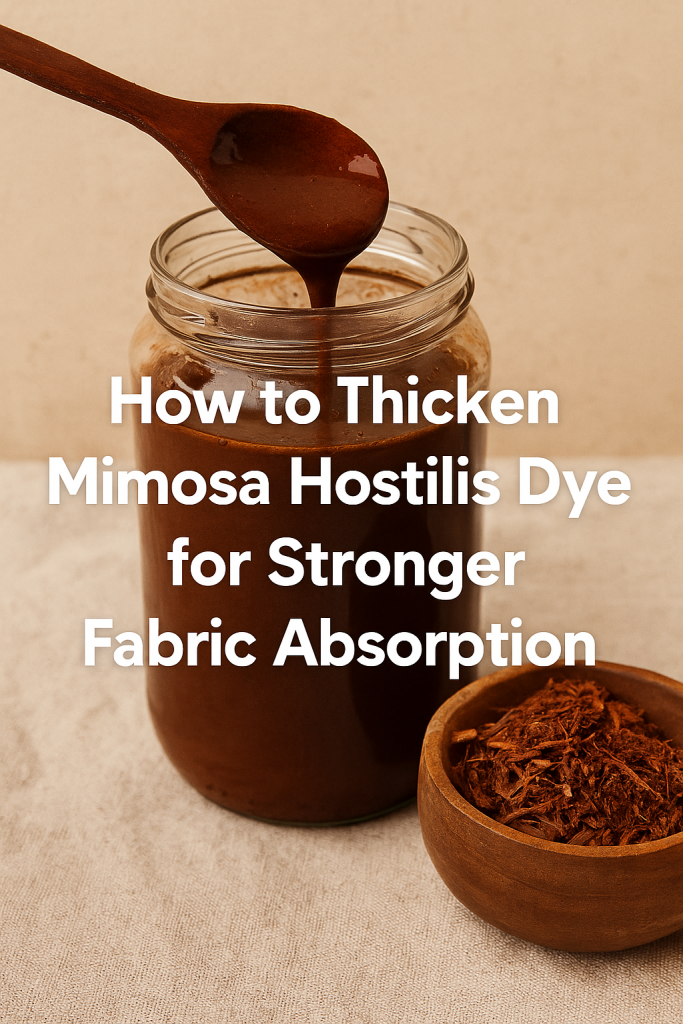
- Stop when the liquid becomes richer, darker, and slightly syrupy.
Why it works:
Reduction evaporates water, concentrating:
- tannins
- pigment molecules
- sugars
- plant compounds
This is the purest and most traditional method for achieving intense results.
Reduction is the foundation of how to thicken Mimosa Hostilis dye for stronger fabric absorption because it never alters the chemistry—only amplifies it.
Method 2: Add Natural Thickeners (Gums & Powders)
If you want a professionally controlled viscosity, this is a game changer.
Safe natural thickeners include:
- guar gum
- xanthan gum
- gum arabic
- sodium alginate
These are widely used in textile dyeing, especially for screen printing and tie-dye.
How to use a thickener:
- Mix ⅛–¼ teaspoon of your thickener in a small jar.
- Add a small amount of warm dye liquid to the powder.
- Shake vigorously until dissolved.
- Add this slurry into your full dye bath.
Why this works:
These thickeners create a gel-like viscosity without blocking pigment absorption.
It’s the most controllable way to thicken dye if you’re doing:
- tie-dye
- direct application
- painted dye patterns
- slow immersion techniques
A little goes a very long way.
This is one of the most precise ways to master how to thicken Mimosa Hostilis dye for stronger fabric absorption.
Method 3: Add Plant-Based Starches or Flours
Many artisans prefer pantry-based options:
- arrowroot
- tapioca starch
- cornstarch
- rice flour
How to use them properly:
- Mix 1 tsp starch with cool water in a cup.
- Whisk or shake until completely smooth.
- Bring your dye bath to a gentle simmer.
- Slowly pour in the mixture while stirring.
Important:
If added correctly, starches thicken without clumping or diluting the pigment.
Why it works:
Starches create a soft, silky body to the dye bath, allowing fibers to grip pigment longer.
This method is excellent for beginners experimenting with how to thicken Mimosa Hostilis dye for stronger fabric absorption using accessible materials.
Method 4: Blend in Additional Tannins
Tannins naturally thicken liquids—they behave like binding molecules.
You can add extra tannin-rich botanicals such as:
- oak gall
- pomegranate peel
- black tea
- sumac
- walnut hulls
How to do it:
- Boil your chosen tannin source in a separate pot.
- Strain the liquid.
- Add the tannin extract into your MHRB dye bath.
Why this works:
Tannins:
- increase viscosity
- improve pigment adhesion
- make the dye bath more “sticky”
- deepen overall tones
This is a more advanced method, but it enhances both thickness and color intensity.
Method 5: Mash or Blend the Bark Extract
After extraction, you can thicken the dye by incorporating more plant solids.
Two ways to do this:
Mash Method
While boiling, mash the bark with:
- a potato masher
- wooden spoon
- stainless steel tool
The finer the particles, the thicker the bath.
Blend Method
- Remove a cup of dye + some bark pieces.
- Blend until smooth.
- Strain to remove grit.
- Add back to the main dye bath.
Why it works:
This increases suspended plant material without creating clumps, which improves adhesion in the dyeing process.
Method 6: Add a Small Amount of Natural Oil (Advanced)
This method is only for experienced dye artists.
Adding a tiny amount of natural oil—such as:
- castor oil
- olive oil
- jojoba oil
—can improve viscosity and create smoother color transitions.
How to do it safely:
- Mix ½ teaspoon of oil with a tablespoon of dye liquid.
- Whisk until fully emulsified.
- Add into the dye bath while stirring.
Why this works:
Oils slightly thicken the bath and slow pigment movement, perfect for gradient or ombre dyeing.
Don’t use too much—excess oil repels water and prevents absorption.
When NOT to Thicken Your Dye Bath
Thickening is powerful, but there are times it works against you.
Avoid thickening when:
- you need even, large-batch immersion
- dyeing extremely delicate fabrics
- seeking pale or pastel tones
- doing high-volume dipping techniques
Thick baths cling tightly and may cause unevenness if used incorrectly.
What Causes Dye to Be Too Thin in the First Place?
Understanding the cause helps you choose the right fix.
Thin dye results from:
- too much water
- not enough bark
- insufficient simmering
- incomplete hydration
- fast boiling that breaks color
- pH imbalance
- dye not reduced
- poor-quality bark extract
- cooled dye bath
- lack of tannins
When you understand these variables, how to thicken Mimosa Hostilis dye for stronger fabric absorption becomes intuitive.
Troubleshooting: What If Your Dye Still Isn’t Sticking?
If you’ve thickened properly but color still appears weak, check:
1. Fabric Prep
Natural fibers must be washed before dyeing.
2. Mordanting
Cotton, linen, and hemp need tannin or alum.
3. Temperature
Cold dye baths produce lighter color.
4. Time
Some fibers require 1–24 hours of soaking.
5. Concentration
You may need more reduced dye.
Thickening helps absorption—but it can’t fix poor prep.
Check out this study on natural thickening agents in textile applications:
https://www.sciencedirect.com/science/article/pii/S0142941817303514 .
Conclusion
Learning how to thicken Mimosa Hostilis dye for stronger fabric absorption is one of the simplest ways to upgrade your natural dye practice. A thicker bath improves:
- saturation
- evenness
- longevity
- richness
- control
- overall quality
Whether you choose reduction, natural thickeners, tannin boosters, or plant-blending methods, each approach allows pigment to cling more effectively to natural fibers.
Once you master viscosity, your results become more predictable—and far more vibrant.
To learn more about the science behind fabric dyeing, check out our other article, https://tenuiflorashop.com/the-science-behind-natural-fabric-dyeing/ .